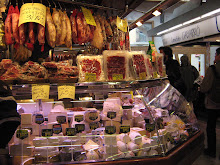
I just got back from seeing “Julie and Julia.” As a self-professed foodie of a certain age, how could I not? The film provoked many questions, like
-How did low level diplomats get such fab Parisian lodging?
--Why does a dinner party in 1950s Paris--with wasp-waisted women and sharply suited men swilling martinis and taking drags on cigarettes-- look so damned appealing?
---Where are the loving, incredibly supportive (indulgent, doting) men of food-obsessed women to be found? (Sign Me Up!)
----What kind of blogs and bloggers get book deals???
Mostly, though, the film took me back to the beginnings of my own love affair with French food.
The first restaurant meal I can remember was at a French (or, in those days, Continental) restaurant where I downed an entire plate of escargot. This was at age two and a half. My first proper cookbook was not Julia Child’s Mastering the Art of French Cooking but a slim volume on French food that was part of a series on world cuisines. I loved making the crème caramel recipe and, as a pre-teen cook, it quickly became my “signature” dish. (I had looked at the Italian volume but it didn’t speak to me they way the recipes in that French volume did; those recipes alchemically transformed eggs and cream into unctuous manifestations of the lick-the-plate divine.) By age 10, my favorite cheese was Camembert. My sister would curl her nostrils when I took it out of its box and tell me it smelled like “death,” but, then again, her favorite cheese was Velveeta.
By the time junior high rolled around, I knew I had to take French rather than Spanish language class. I endured three years with M. Summer-- an oversized Hercule Poirot, his chubby nail-bitten fingers methodically combing his 70’s ‘stache as he thought of how best to insult you for your ‘ideous pronunciation or stupid! ridiculous! grammatical mistake. But I endured that soul-squashing language teacher because I knew that, one day, I would speak my language of love: the language of la cuisine francaise.
My parents, as with all things gastronomical in my life, are to blame for this obsession with French food. We didn’t have much money when I was younger and as I got older it came in great hailstorms punctuated by long droughts. No matter what, my parents spent their disposable income on going out to eat. We went almost exclusively to French restaurants. I cannot remember the restaurant’s name but I do remember a place in the eastern SF Valley, its exterior painted with the tri-color scenes of Paris, and driving back happily sated in the warm night air of an LA summer. (That my father had a 1959 white convertible T-bird that we drove slowly down "The Boulevard"—a.k.a. Ventura Blvd, the main artery of the San Fernando Valley—is a good part of the memory as well). Then there was René’s and the Seashell and, later, La Serre. At René’s I was introduced to pâté au compagne and those gorgeous, addictive pommes soufflés—airy and crisp and salty. At the Seashell, I ordered fish--which I never ate at home or anywhere else, because it was bathed in butter and sometimes butter, cream, AND shrimp. At La Serre, I always started with the Feuilleté aux Quatres Champignons (and so my love of morels began). Somewhere I was introduced to Oeufs à la Neige. Clearly I was child cream addict. Beyond that, though, is what I really loved about French food: its ability to balance in perfect Taoist contradiction the extremes--rustic and earthy was also refined; luxurious was also delicate; simple was complex.
I finally made it to France at age 36 or 37. It did not disappoint. The apple pastry from Poilane, its crust so rich in butter that the paper bag was soon stained with a Rorshach of ecstasy. At the gilded Laduree, the sublimely delicate rose macaron filled with rose ice cream. In Normandy, the vergers and their simply perfect farm lunches of duck rilletes, goat cheese, salad, and cidre. And, of course, there was the CHEESE. (Next up will be a blog-ode to Vacherin de Mont D'Or!) In Dijon, at Restaurant Jean-Paul Thibert, I had the most memorable meal of my life: a 12 course culinary narrative that lasted four and a half hours. On my return to Paris, I immediately called my mother to tell her about the meal, mouthful by surprising mouthful. I knew she would understand my giddy reverie.
Perhaps I will make it to France next year. I hope so. Almost as good is that my son heads out to France next week for a four month stay in Lyon. I cannot wait for that "guess-what-I-just-ate?!"phone call.
Wednesday, August 19, 2009

Tuesday, June 2, 2009
My SF Crush
You know the guy you start finding yourself liking more and more, rather unexpectedly and against your better judgment? The guy who, at first, you liked casually, fraternally but the more you got to know began to feel a giddy affection for?
Well, I found that guy. Only it wasn’t a guy. It was a bakery.
I just spent two weeks apartment-sitting in SF, one block away from Tartine Bakery. I have many friends who have spoken highly of the place, some fanatically so. They showed me their Tartine cookbooks with reverence, touching each glossy photo as if their fingers could lift meringue or powdered sugar into the third dimension. I liked the treats they brought: the cocoa nib or toasted almond Rochers, the gougeres, the lemon bar. I even found the banana cream tartlette to be worthy of, well, hiding and having a sort of proprietary relationship with later. Mostly I enjoyed these pastries with appreciation for the art but I could never quite achieve the quasi-sexual reverie they had. I knew my food type fell mostly in the category of large, meaty and, preferably porcine.
Because of all the hype, I decided I had best make a trip to the bakery itself. After all, I needed coffee and it was a short walk. A half a block away it hit me. A wonderfully familiar yet also idealized smell. Not just the yeasty-sugary smell that wafts out of every bakery. This was different. It transported me back to a childhood place where baked goods smelled REAL. Too many bakeries these days smell overly redolent of sugar such that the air takes on a kind of sourness. I could smell yeast (but not like when I used to ride the RTD in LA past the Anheuser-Busch brewery—now that’s yeasty and a whole other story…) and sugar and almonds and vanilla and a hint of citrus—all in perfect proportion. I was excited but a little skeptical: could it really be as good as its smells foretold?
I stood in line. A very long line. Internally I harrumphed—what pastry can be worth such a line? A camembert, a vacherin mont d’or, or even exquisite gorgonzola—now those command devotion. I'll admit: everything did LOOK good. I ordered an almond frangipane croissant and, because I was on re-con, I also ordered a piece of quiche. To go back to the guy analogy, it’s like getting to know both his soft, sweet side and his more practical, logical self. If you just like one, it’s maybe good for a dalliance but you need compatibility with both for a relationship. I needed to know if this bakery was going to be worth my time (and serious amounts of cash: $3.75 for a croissant, $4.75 for a piece of quiche) or if we were destined for only an occasional fling. After all, bakeries really aren’t my thing (a.k.a he’s not my type). I actually think I’m a little allergic to yeast. And, besides, if I have to choose fat calories, wouldn’t I rather get them from something that also had a little more nutritional value, like salami?
Ready to dismiss all the hullabaloo and stick steadfastly to my not being one of “those” girls (i.e. those who stereotypically ooh and aah over things chocolate and bread-y), I was poised to be unimpressed. The quiche, however, was a revelation: soft yet sturdy custard that was an excellent foil to the salty ham, all enveloped in a buttery, decidedly unsoggy, brioche dough. The croissant was a big-hearted sandwich of a thing. It was split in half and spread with frangipane-- the frangipane sweet and aromatic but not cloying, the dough buttery yet just a bit brittle. I was more than pleasantly surprised. I was intrigued.
I returned to the bakery just about every day and I learned new things, each more enticing than the next. The dense suppleness of the almond teacake. The complex heartiness of the cake aux olives. The lusciousness of the tres leches cake. The I-have-never-had-a cake-so good-as-this lemon meringue, caramel layer cake. While the slice of that cake may have sealed the deal—-oh, yeah, I was now in serious “like”—-it was something more humble, more quotidian (as it usually is) that cemented this relationship. One Saturday, after 5pm, my son and I walked in. He was the third or fourth person I had brought to the bakery, extolling and enumerating the bakery’s virtues to each of them as if the bakery were a new beau (and face it, it was). We had just bought more than a few pastries when I noticed they had just taken the bread out of the oven. Add a loaf to our tab, please. Back at the apartment, my son set out plates for the pastries while I tore into the still hot loaf of perfectly crusty country bread. I set a small knob of salted butter on top and watched it melt into the airy interior. This was THE BEST bread I had ever had. I have never, ever been so smitten by a baked good. I was positively giddy. Dammit: if you can do a perfect loaf of bread AND a sublime lemon cake, you’re the man,I mean, bakery, for me.
I’m back at home now. No more Tartine just down the street. I think wistfully upon it, not wishing to replace it with another local bakery but just reliving the excitement of a spring fling. But I did learn something. Sometimes right in front of us, or down the street, there is something you can dismiss as not your type. But if you allow yourself to follow your senses, you may find he’s your type after all. Of course, whether you’re his is another matter entirely.
Tuesday, May 5, 2009
Growing Distance
(In honor of mother's day, I thought I'd share a poem I wrote on my adopted son's 21st birthday.)
Underneath this
great-boughed tree, its
branches low, needles arc-ing
over us in fountain sprays,
we share
a picnic table,
my son and I.
Folding his limbs
to fit
upon the narrow bench,
he stretches out,
falls into
an easy sleep.
A thin strip of belly
between waistband and shirt
gently rises
and falls.
I watch
to see that he is
still
breathing. He rustles,
pulls the woolen cap over his face,
makes
his explanation:
To stop the chestnuts
from hurting
if they fall.
That’s not
going to protect you, I say.
But it will
ease the blow.
I look to the woods
wishing for
Lilliputians to emerge, come
to bind him
to this moment. For
what will ease the blow,
I wonder,
when I can no longer
watch him sleep,
when I no longer
see the six year-old boy
in the man’s face?
Tuesday, April 21, 2009
"In nature and the language of the sense, The anchor of my purest thoughts..."(or the Diagnosis Part II)
I live in a stunningly beautiful place. Surrounded by madrones, manzanitas, and vineyards, the property on which I am lucky enough to live also affords me glorious views of the oak-studded California hills, a sometimes-rushing-sometimes-dry creek and, particularly spectacular at the moment, three dogwood trees covered in ivory, four-petalled blooms.
In the mornings I walk down the road, past lizards sunning themselves, to the vegetable garden. Here, the farmer’s constancy is aided by the alluvial soil and everything grows brazenly, from the springtime favas and rhubarb to the summer’s sweet corn and tomatoes. In the afternoons, when I take the dogs out gopher hunting (they catch nothing but definitely enjoy the dig), quails traverse the road unsteadily, like besotted dowagers in party hats. Driving home on a moonless night I must be attentive to the jackrabbit zigzagging across the road; the foxes are faster so I only catch a glimpse of a bushy tail being sucked into the brush. Occasionally, a pointy-eared bobcat lopes across the driveway. Frogs sing me to sleep and coyotes disturb that sleep with high-pitched cries no different from the ululating wails of women in grief.
As the determinedly hot days give way to unhurried breezy nights, the uncluttered, certain sky becomes a layering of Braille on an indigo page. It is easy to breathe deeply here, to find one’s angle of repose. But as much as the beauty of this place brings me a contemplative stillness and unquantifiable gratitude, I am restless.
I remember this feeling from many years ago. I was living in another rural, wonderfully beautiful place: the Pocumtuck Valley in western Massachusetts. Farmland, rolling hills, a river, plus the New England seasons. After two years living there, I had to leave.
Now, as I did then, I realize that when I live so close to nature, I am overwhelmed. As I should be: Nature is profound in its beauty, power, mystery. Here I have fallen into an intoxicated stupor of submission. It is exactly what the poet Rumi writes about: that drunken love one experiences upon meeting G-d. All there is for me to do is luxuriate in this beauty. And so, prostrate before Nature’s magnificence, I do nothing. I feel too small, too insignificant. What can I possibly do to contribute to THIS?
Knowing my smallness in all of this makes me ready to leave Eden. But not out of a sense of inferiority, rather out of an understanding. Yes, in the grandness of Nature I am small. Just as a single jackrabbit or oak tree or creek is. But small and solo don't mean insignificant.
I don’t know that I will ever live in a place as beautiful as this one again, but I have been given an inestimable gift to have lived here for six months. I have been embraced by Nature--indeed by G-d--and shown the grandeur of this world to which I am not merely a witness but a bonded actor. And now strengthened by that embrace, I must go do my part.
(Note: Blog title from Wordsworth's poem "A Few Lines Written Above Tintern Abbey")
Saturday, April 18, 2009
Snakes and Snails and Puppy Dog Tails (or the Diagnosis, Part I)
Yes, I have eaten two of the three. I have eaten an entire banquet made from snake in Hong Kong--I particularly enjoyed the stir-fried snake with chrysanthemum but the rest of the dishes didn’t do that much for me (then again neither does chicken). I do enjoy snails, though, to be honest, most snails are like nuggets of dark brown, rubbery tofu so, as with tofu, it’s really all about the sauce. And, at least when the snails are prepared in the West, the sauce usually involves butter. I have not and will not ever knowingly eat dog, though a roast dog seller on QingPingGaai in Guangzhou, China once tried to convince me otherwise. While I remained steadfast in my conviction not to eat it, I could not stand fast at his stall and so hightailed it out of there (you may disregard the pun). At any rate, the title refers to something I have been missing. Not in my diet but in my life.
I knew that something was amiss was when I began to experience food ennui. Last night, I told a friend I really didn’t care what I had for dinner and she looked at me--the poster child for “Live to Eat!”—in alarm. I’ve been searching for the cause of my dining indifference and have come to the conclusion that my life is imbalanced.
I am a great believer in the Tao; I know that too much or too little of something disrupts life’s harmony.* Coming in the “too little” category is time spent in the “Bro-zone;” that is: I am missing boy energy.
Okay, this seems to make little sense. I am a forty-something woman. I have many, many close women friends. I went to a women’s college. I read Sisterhood is Powerful and In a Different Voice several times. I hate the oppression of patriarchy and the violence it has bred. I don’t abide bad table manners, “Dutch ovens,” or contests that involve distance urination. And, having been the dorm mother to 40 high school boys at an East Coast boarding school, I think boys smell bad. Or at least their rooms do, especially if their sweaty hockey uniforms are left drying on the radiators. Eeewww.
In spite of all that, having spent a good deal of the last 25 years around boys and adult males who can easily access their “boy-ness,” I realize that whether you’re a boy, an adult male, or a female, you can experience a lot of positive energy in the “Bro-zone.”
Without benefit of a sociology degree, extensive reading into evolutionary biology, or special attention paid to post-modern gender theory, here’s my highly un-nuanced, overly generalized take on what’s good about boys.
• Their desire to dog-pile, like puppies, whether on a grass field or in the back of a taxi-cab: it’s rambunctious, intimate, messy and someone usually gets hurt but doesn’t complain.
• That they can be picky without being fussy: that is, boys seem to be clear about their wants/needs and come to resolution quickly about how to respond when they aren’t.
• That they have a less angst-ridden relationship with their bodies than females do; they have little day-to-day concern with their bodies.
• That they trust their senses.
• That they like jokes--the practical, the scatological and the punny--and laugh with ease.
• That they form their bonds through doing things and so their memories and loyalties are etched deeply, right down to the cell-level.
• That they are curious and open to possibility (i.e. they're risk takers).
• That they can trust easily (and can be almost irrevocably hurt when betrayed by someone to whom they have given their loyalty).
• That they can stand alongside; they might not always know what to say or do but they will stay in the zone so as not to leave the person alone and unprotected.
• That they don't run the Social Communication De-coder at all times; a cigar can just be a cigar. (Okay, that was a bad example as phallic reference runs high in the bro-zone; the point is, boys can take a comment as it is said, unless it even remotely references anatomy or sex.)
• That they give their friends a lot of room to mess up, to be weird, to be themselves.
In short, at its best, the bro-zone is physical, fun, goofy, less verbal, straight-forward, loyal, protective, less focused on analysis and more on being & doing. I need more of that in my life. You?
*(Caveat: butter, cream, pork and good bourbon are excluded from the “too much” category; any amount of these is the perfect amount.)
Thursday, April 16, 2009
Canary Meet Coalmine
It doesn’t take much to get me excited. Mere mention of pork in some form—bacon, trotter, ham—or a runny French cheese or a seared rib eye makes my eyes sparkle in joyful anticipation. I am ALWAYS thinking of what delights the next opportunity to cook and to eat will bring. Every meal represents creativity, pleasure, choice.
But lately…something is amiss. I feel as if I am stranded on a barren shore, with no culinary wind to roust my sails and set me a-sea again. So much so that even a luscious ramekin of rhubarb custard the other night could not float my boat. I had lunch today without once thinking of all the options--pupusas? ceviche?burger? I came home and ate whatever was on the counter. (Some pretzels, a handful of almonds, and a half an avocado.) My palate lethargy signals "Danger, Will Robinson! Danger!" My palate, my love of food is my compass. When my palate fatigues, it means I’m not on true north.
I began to wonder where I had gotten off tack. Perhaps I have been neglecting my other senses. Those of us who love food are usually sensualists. We feast not only on taste but also on:
smells—a bouquet of freshly cut lilacs or the rich earth newly plowed;
sights-- the sunlight playing hide and seek among the oaks;
sounds--the caress of Alan Rickman’s voice; and
touch--a cashmere sweater holding you close (or, even better, a cute man in a cashmere sweater holding you close).
So I did a check of my sensory world to determine if my palate was in a funk because another sense was being under-utilized. You know: sometimes when part of the system goes down, the whole thing gets affected. I had to conclude, well, no, my sensory life is pretty dang rich.
More diagnosis is needed. I mean, a girl without her pork joy is a lost girl indeed.
Wednesday, March 18, 2009
Make It a Double Old-Fashioned
I am, as mentioned in earlier posts, a brown-liquor girl. While I can appreciate the clever dexterity of the modern mixologist, I tend to go for the unfussy but classy old school choices: the Manhattan and the Sazerac. When I wrote this to a friend, he (pun-ishingly) replied that I was an “Old-Fashioned” girl. Although he may have been talking about my choice in cocktails, I think the lower case version also applies.
That I like the classic cocktails perhaps says less about my palate (though I do like the caramel honey taste of whiskey, bourbon, and rye) than about my relationship to the world. Those drinks suggest something clubby, like the drawing rooms of English manor houses in Masterpiece Theater dramas where men retire to sip aged whiskies in front of a roaring fire flanked by two Scottish deerhounds. Part of the attraction, if I must be honest, is what attracted Charles Ryder to Brideshead. No, not Sebastian, but the whole social echelon to which I can never gain entry. I don’t really want entry (do I?) but I want the romanticized version of it, where comforts envelope you like a wreathing of sweet cigar smoke and where dinner is an enough of an occasion that one needs to dress for it. Sipping an amber-hued, cherry bejewelled Manhattan is like sipping that world but without all the racism, imperialism, classism, sexism and tubercular consumption that go with it.
Too, I think classic cocktails, white or brown, suggest a formality that, say, a Sex on the Beach or Cape Codder cannot muster. While I am not in the least formal, I would be lying if I said I didn’t like a good dose of propriety. Yes, I like rules and precision. I like manners and etiquette to the extent that they are intended to make everyone more comfortable. If I must be uncomfortable (e.g. not chew with my mouth open) so that someone else can enjoy his meal, then so be it. A little giving up of one’s personal interest for the greater good seems a fair trade to me. (I know this may seem a bit contradictory given what I said about my attraction to upper crust salons.) All of this is embodied in a classic cocktail. Its proportions are precise, the shape of the stemware specified, the expectations for its being imbibed genteel (i.e. sipped rather than slugged, chugged, or downed).
I think, though, what I'm really getting at is that I want the ritual that cocktails or the cocktail hour, at least in my imaginings, suggest. Not in the 1950s parodied form where ruggedly handsome dad has polished off four martinis in quick succession and perfectly coiffed and rouged mom is soused from the cooking sherry she keeps pouring herself. Rather I want to reintroduce a time of repose into our day, a time of transition where we go from the ravages of the day into the reflective sanctity of the evening. Rituals tether us to time and place and connect us to others. In these times of uncertainty, it is easy to feel unmoored. Here, in the ritual of preparing a cocktail—measuring the ounces into the shaker, pouring the mixture into the appropriately chilled and chosen glass, garnishing the sparkling drink with an edible—we come back to the present because a cocktail, unlike a beer or glass of wine, must be made not simply poured. (Were alcohol not verboten for Buddhists, I think preparing a cocktail would be the perfect Zen act and the Pousse Café the perfect Zen drink.) We then sit, our cocktail perched on its little napkin, bowls of nibbly things on the side tables, and we chat. As we sip our cocktail (note it is singular not plural), we relax into our bodies, we enjoy the camaraderie of friends, and note our appetites returning. In this way, a cocktail is neither a crutch used to get through the day nor the focus, just as lighting the candles or eating the challah on Shabbat is not the point of the ritual, though it is integral to the structure. In a way, drinking the thing is not the point. What matters is the intention, attention, and belief that at least some part of our day needs to be sacred. I choose to mark that part of the day with a Manhattan, a Sazerac, or an Old-Fashioned.
Now if I could only re-introduce Game Night and Sunday Night Dinner, I’d be a happy old-fashioned gal.
Subscribe to:
Posts (Atom)